THE JOURNAL

Ryan Gosling in “Project Hail Mary” (2026). Photograph by Jonathan Olley
Famously, in space, no one can hear you scream. But also, when it comes to clothing, there are pieces that just scream “space”. Spacesuits, mostly. Clothing built to function in the vast, celestial vacuum beyond the safe embrace of Earth. Designed to protect the relatively fragile human body from ambient radiation, temperature extremes and wayward particles of debris. And, as good as they are, your ripstop cargo pants have nothing on the next-generation Axiom Extravehicular Mobility Unit that Nasa is trialling for future moonwalks.
We’re counting on Project Hail Mary to lean into this wardrobing. Primed for take-off this month, the film stars Ryan Gosling as a schoolteacher who wakes up in a spacecraft many light years from home. Being based on the novel by Andy Weir, the hard science-fiction author behind The Martian, this is a story that focuses on plausible near-future technology. Which means that what you see on the screen is close to what you’d wear in the real scenario, should it ever happen. (Hey, we can dream.)
When it comes to astronaut fashion, it pays to aim for the stars. But also, not to fly too close to the sun. Below, five movies that got the interstellar dress code just right.
2001: A Space Odyssey (1968)

Gary Lockwood on the set of “2001: A Space Odyssey” (1968). Photograph by Sunset Boulevard/Corbis via Getty Images
“A man should look as if he had bought his clothes with intelligence, put them on with care, and then forgotten all about them,” Sir Hardy Amies once quipped. Which might be pushing it when it came to outfitting the astronauts in Stanley Kubrick’s 2001: A Space Odyssey. To say that Kubrick was a details man is something of an understatement. But the director who meticulously archived his vast research for every film he produced in boxes that he also had custom made was himself known for outside-the-box thinking, too. Hence when it came to the costumes for his 1968 sci-fi masterpiece, he turned to the Queen’s dressmaker.
As a Savile Row tailor with a royal warrant, Amies was able to meet Kubrick’s exacting standards and entertain his questions about fits, fabrics and buttons. The film also presented an opportunity to explore the more free-spirited fashions of the Space Age. However, the curator of Amies’s own archive has argued the results “weren’t very futuristic at all. He did that because he didn’t want the film to date. Amies was a great believer in the understated – he wanted clothes that worked in the city, the country and on the spaceship.”
Sunshine (2007)
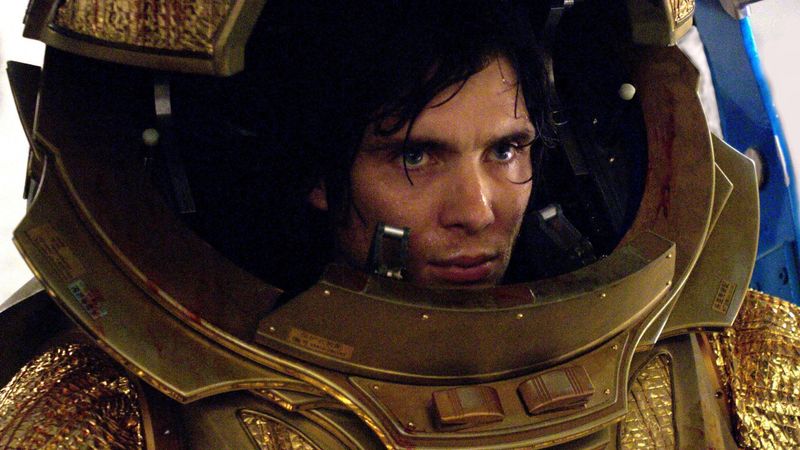
Cillian Murphy in “Sunshine” (2007). Photograph by Cinematic/Alamy
There was sound reasoning behind the gold spacesuits in Sunshine, Danny Boyle’s 2007 space thriller, which stars Cillian Murphy, Rose Byrne, Michelle Yeoh and Chris Evans on a mission to revive the dying sun. While the film itself cherry-picks visual elements from the likes of 2001, Solaris, Event Horizon and Alien, the hardware came together following consultation with Nasa.
The concept of gold-leaf shielding was taken from that deployed on satellites to deflect heat and radiant energy. The hooded helmet with its horizontal visor slit, however, earnt comparisons with a certain character from the cartoon series South Park, hence the suit was known on set as “the Kenny”. Which is proof that, even in space, inspiration can come from the most unlikely of places.
The Right Stuff (1983)
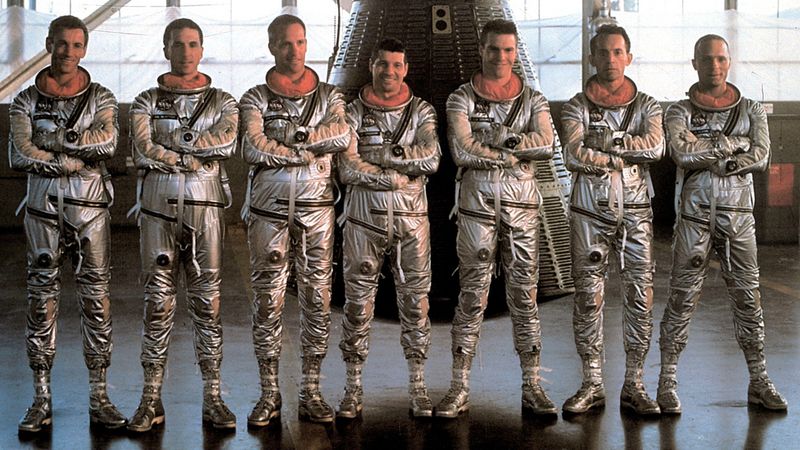
Scott Glenn, Scott Paulin, Charles Frank, Fred Ward, Dennis Quaid, Lance Henriksen and Ed Harris in “The Right Stuff” (1983). Photograph by AJ Pics/Alamy
The suit you most likely associate with the writer Tom Wolfe was his signature white one. And yet his 1979 book The Right Stuff – written in a blend of news reportage and literary narrative which Wolfe coined as “the New Journalism” – and 1983’s film adaptation capture the birth of the astronaut and the spacesuit as we know it.
The story follows the test pilots selected for Project Mercury and the race to get an American into orbit ahead of the Soviet Union. The Mercury spacesuit was a full-body, high-altitude pressure suit first designed for US Navy fighter pilots. The primary purpose of its aluminised nylon outer layer was to offer thermal protection, but the silver coating came to stylistically define the age. Accessories such as pilot watches, as well as off-duty attire (notably flight jackets), also stuck to the aeronautical origins of the programme.
The Martian (2015)

Matt Damon in “The Martian” (2015). Photograph by Ent-movie/Alamy
In keeping with its source material – as mentioned, Weir’s 2011 debut novel is noted for its technical accuracy – the spacesuits worn in the 2015 film The Martian track with what is possible based on current scientific knowledge.
The costume designer Janty Yates, who also worked with the director Sir Ridley Scott on Gladiator, Prometheus and Napoleon, took inspiration from Nasa’s Z-2 prototype, in particular. This spacesuit was pitched towards a future mission to Mars, where the surface gravity is less than 40 per cent of Earth’s but more than twice that of the moon. The costume was built from neoprene, with a “cooling suit”, featuring tubes circulating cold water, underneath.
The film’s suit, however, diverts from Nasa’s, which features a helmet moulded to the shoulders rather than as a separate section. “Ridley needed to see his actors in profile,” Yates has said. “He needed to see them moving their heads; he needed close-ups on the eyes.”
The Hitchhiker’s Guide To The Galaxy (2005)

Martin Freeman in “The Hitchhiker’s Guide To The Galaxy” (2005). Photograph by AJ Pics/Alamy
As Douglas Adams writes: “Any man who can hitch the length and breadth of the galaxy, rough it, slum it, struggle against terrible odds, win through and still knows where his towel is, is clearly a man to be reckoned with.” Which may be the case. However, a terrycloth robe will also take you far, as demonstrated by Martin Freeman’s Arthur Dent in the 2005 adaptation of Adams’s sci-fi comedy. (Although the outfit worn by the character isn’t actually mentioned until the third book in the series.) Teamed with pyjamas and slippers, it suggests a man at ease in any situation anywhere in the universe. Even Vogon poetry recitals.
The people featured in this story are not associated with and do not endorse MR PORTER or the products shown