THE JOURNAL

Domhnall Gleeson in “About Time” (2013). Photograph by Murray Close/Getty Images
Former US President Barack Obama always wore the same outfits. Why? So he could spend time on more important things. Unlike us, he didn’t want to be lying awake at night worrying about whether his new Bengal-striped shirt went better with unwashed or faded denim. “You’ll see I wear only grey or blue suits,” Obama told Vanity Fair in 2012. “I’m trying to pare down decisions. I don’t want to make decisions about what I’m eating or wearing. Because I have too many other decisions to make.”
Psychologists call this “decision fatigue”. The simple act of making decisions inhibits your ability to make further decisions – as those of us who are paralysed by choice in the ready-meal aisle at the end of a long day will recognise.
Deciding what to wear each morning can waste time and mental energy – and that’s partly because, according to a report in The Wall Street Journal, we only regularly wear 20 per cent of what we own. Which means the vast majority of our wardrobe is clutter.
When you open your cupboards, do you feel as if they’re bursting with stuff but there’s nothing you want to put on? Do you wear everything in your wardrobe or are there items you haven’t touched in more than a year? Can you access everything in there or is it so crammed full of clothes, you only wear what you can prise out?
“Having less isn’t about deprivation”
It could be we’re suffering from a modern-day problem called “stuffocation” – a term coined by the writer James Wallman, and the title of his book on how to live more with less. “Having less isn’t about deprivation,” Wallman says. “It’s about getting rid of the stuff you don’t wear anyway, so you can easily see and get to the things you do like wearing.”
Why are so many of us turning into closet hoarders? We cling on to garments that don’t fit or are damaged with the indefinitely deferred intention of having them altered or fixed. Some things we keep for sentimental reasons. Some out of guilt, because we feel bad about throwing away an expensive piece and thus admitting that its purchase was an error.
But keeping stuff we don’t need just adds to the background interference of our lives. We could all do with a September wardrobe detox. Here, Wallman offers some practical advice to help you get rid of the stuff you don’t wear, access the stuff you want to wear and upgrade or replace items you should no longer wear.
01. Divide and conquer
Allocate at least two hours for a wardrobe purge and psyche yourself up to be ruthless. This is not a job to do half-heartedly or in stages. If wardrobe editing is not your thing, ask your partner or a friend to help you decide what stays and what goes.
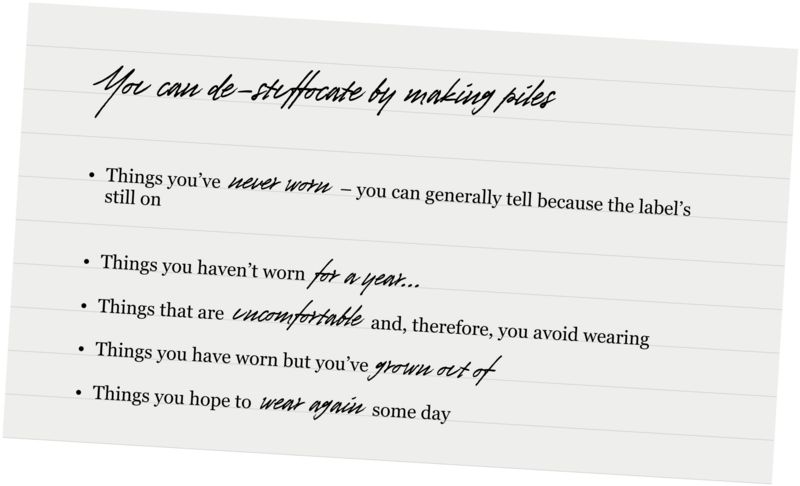
If you’re taking your time, put them in separate bags or boxes and put them in the loft. If you haven’t missed them in three months’ time, you don’t need them.
02. Adopt a reverse hanger method
Struggling to let go? Put all your hangers facing the same direction. If you wear something, when you put it back in the wardrobe, hang it facing the other way. At the end of a month, you’ll know how much of your wardrobe you really use. The rest either needs to go into the loft until the summer or be recycled. Don’t bin it – the UK already throws £25m of clothes into landfill each year. Instead make sure all items are clean and donate to your local charity shop or homeless shelter.
03. Conduct the box experiment
This is an extreme tactic for brave (or desperate) people seeking instant change. Put everything – yes everything – in cardboard boxes as if you were moving house. Write their contents on the outside of the box. Each day, as you need something, take it out of its box and gradually repopulate your wardrobe and cupboards. This way, you’ll find out what pieces you actually need and might be surprised at the pieces you forget about entirely.
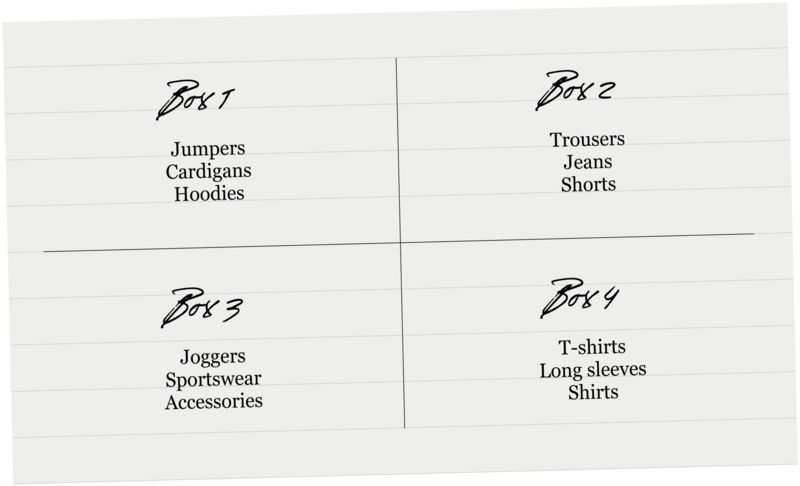
04. Play the “Did you miss it?” game
This is especially effective if it’s your partner’s wardrobe that’s causing the problem. It’s a simple game: you hide something and if the other person does not notice it is missing for a set time – say, a month – he or she clearly did not need it, so you can decide together to get rid of it. (Important note: MR PORTER does not accept responsibility for any “domestics” that may ensue.)
05. Reduce decision fatigue
Declutter your life by folding things neatly, hanging everything in the right place, storing shoes and bags in a way that makes them immediately visible and accessible. You can also mend or clean items that require attention within a week and sell or give away the pieces you’re not wearing. This will make dressing easier and shopping more successful – because you’ll know how your wardrobe is functioning and what you need to fill the gaps.
06. Operate a “one in, one out” policy
Think of your wardrobe as a top-notch nightclub where you are the doorman. Once you have got your wardrobe in order, avoid re-stuffocation by donating an item each time you buy a new one. This is a disciplined way of keeping your wardrobe edited, prioritising quality not quantity. It should also put an end to frivolous, badly thought-out purchases.