THE JOURNAL

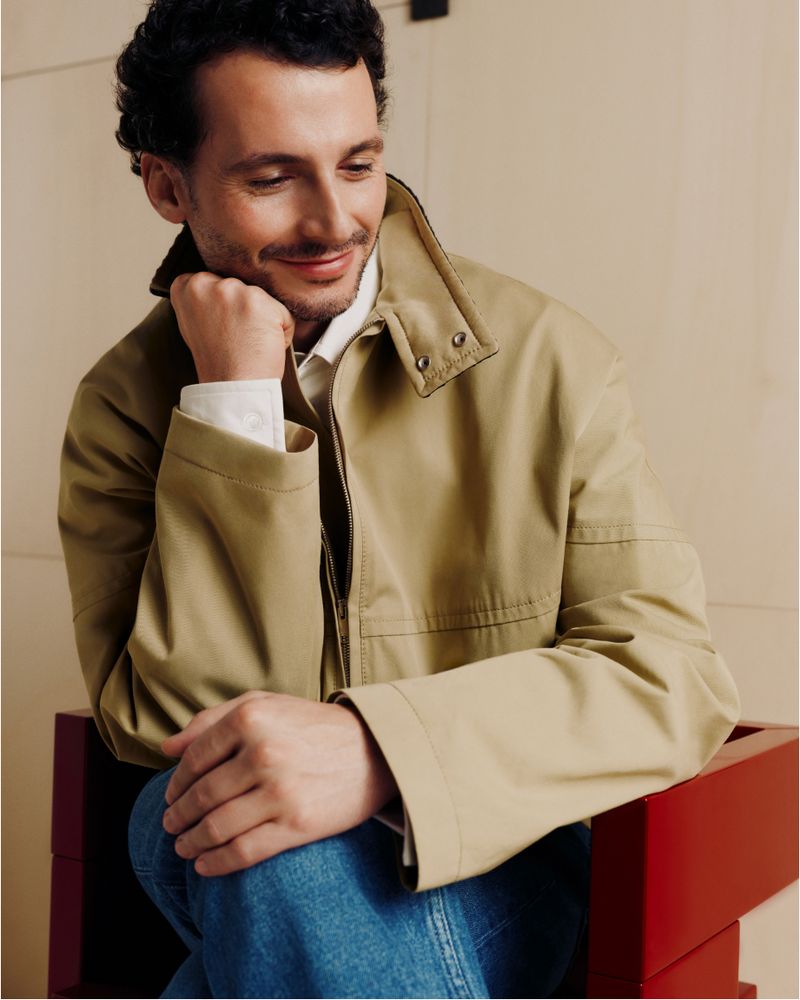
Milan has long been a melting pot of style and design. A place where fashion, architecture and craftsmanship are in constant dialogue. That balance of visual rigour and creative experimentation underpins Bottega Veneta’s vision, and equally shapes the thoughtful, collaborative ethos of design duo Studioutte – here modelling Louise Trotter’s debut lineup for the house – for whom the city is both a working base and an enduring cultural compass.
The Palazzo INPS building, a state institution dedicated to social security, looms over Piazza Missori in the heart of the city. Designed by the architect Marcello Piacentini, its façade is austere, wrought in slate-grey stone and articulated by two rows of arched windows framed by paler pilasters. On the lower floors, allegorical sculptures lean out over the street, while a series of symbolic friezes illustrating themes of labour and social welfare wrap the hulking, oversized entranceway.
This stark bureaucratic edifice is not often the first port of call when one imagines Milanese design. More commonly, attention turns to the Rationalist lines of the sumptuous Villa Necchi, designed by Piero Portaluppi, or to the distinctive diamond-shaped footprint of Gio Ponti’s Pirellone office building – both paragons of the city’s modernist legacy. But for Patrizio Gola and Guglielmo Giagnotti of the Milan-based architecture and design practice Studioutte, the infatuation lies with the architecture of a lesser-known era.


“We’re a fan of the work that was built in Milan before the war,” explains Gola, referring to the oeuvre of Italian architects such as Piacentini and his contemporaries, including Giovanni Muzio and Ignazio Gardella, who developed an architectural language that bridged classicism and modernism.
“Objects are part of the architectural landscape. It’s almost a mathematical approach to what an interior can be”
“These architects were able to synthesise historic Italian architecture into a new language,” Gola says – one that retained the proportions, gravitas and material richness of the past while stripping away ornament in favour of clarity and order. “When you see even a window by an architect like Muzio up close, the design is so subtle and poetic,” Giagnotti adds. “Everything is balanced and deeply considered.”

Though neither Gola nor Giagnotti was born in Milan – Gola is from the mountainous northern province of Sondrio, while Giagnotti was born and raised in Puglia, in the south – the pair have long been students of the city’s architectural history. They founded Studioutte in their adopted city in 2020 after meeting while working at the design firm Dimorestudio.
Their predisposition to collaboration and connectivity is the same that runs through the history of Bottega Veneta, and Trotter’s first collection is a clear example. The language of Bottega Veneta, intrecciato, “woven” in Italian, celebrated its 50th birthday last year. Under the new creative vision, it’s rendered for spring and summer through weekend bags, a modern take on your everyday briefcase, loafers and details on overshirts and jackets. Elsewhere, elevated utility jackets and commanding tailoring that riffs on classic Milanese style cements Trotter’s fascination with the city.
Though Stodioutte’s work, too, draws heavily on references from the canon of Milanese architecture, they also look beyond it. Giagnotti spent a period working in Antwerp for the Belgian architect Vincent Van Duysen, an experience he sought out in response to a longstanding fascination with the country’s art and design culture. “I was always attracted to Flemish painting as a kid,” he says, referring to the dark, meticulously rendered still lifes of the 17th century. “I always liked those kinds of worlds.”
The interiors the pair design carry a similar sense of hybridity and drama. Moody, perhaps – washed in dark colours and alive with carefully calibrated shadow – yet often markedly spare, with generous expanses of negative space in place of superfluous objects. Historical references are present, naturally, but never without contemporary counterpoints, often introduced through materials such as stainless steel or sculptural furniture custom-designed by the studio.
In a recent residential project in central Milan, spaces are divided by parchment-coloured curtains that hover alongside monolithic elements – a brushed steel headboard, for instance – and textured silk wall coverings that recall Japanese tatami. The effect is at once austere and atmospheric, a succession of thoughtfully staged mises-en-scène that strike a delicate balance between severity and softness.


The clearest expression of Studioutte’s research and conceptual approach, however, can be found in the installations they stage each year during Milan Design Week. Their first major presentation, Temporanea Galleria, explored ideas of ephemerality and display through an enveloping environment in which furniture and objects appeared as fragments within a temporary architectural setting. In 2024, the duo expanded on these ideas with Sala d’Attesa, a cinematic scenography that transported visitors into a low-lit, windowless interior. Custom furniture – from lacquered chairs to tiered ceramic vessels – inhabited a space intended to feel removed from the passing of time.
Most recently, they unveiled an installation at their Isola neighbourhood office titled Atollo. Conceived as a room existing as a self-contained structure, the project centred on a square pedestal table framed by built-in benches with throne-like backrests. Both the furniture and the walls were formed from a modular system of pale wooden panels. Atop the table, rows of white flowers emerged from the surface like a field of pegboard. The panels, repeated across the walls in a strict grid, were intended to evoke the stone cladding of Otto Wagner’s Secession-era architecture in Vienna.

“The modules don’t just define the space,” explains Giagnotti. “They also define each component of the space, including the furniture. Objects are part of the architectural landscape. It’s almost a mathematical approach to what an interior can be.”
This method – seeing both large-scale architecture and the smallest of objects that occupy it as part of a larger, cohesive system – is a refreshing perspective in the landscape of Italian design, which can often rely heavily on nostalgic indulgence and grand, theatrical gestures. Instead, Studioutte’s work is concerned with interpreting history through contemporary ideas and research, a notion that explores their forebears’ ideas, rather than simply replicating their forms.
