THE JOURNAL

The definitive MR PORTER guide to suits.
Mr Alan Flusser, the designer and tailoring buff who dressed Mr Michael Douglas for his turn as Gordon Gekko in 1987’s Wall Street, once said: “If a man runs for president, interviews for a high-level job, or needs a good table at a smart restaurant, chances are, he’ll be wearing a suit. The tailored jacket with matching trousers remains the uniform of official power, suggesting civility, diplomacy and physical self-control.” Whatever your relationship with tailoring – whether it’s the foundation of your weekday uniform, or something you reluctantly wear when occasion dictates – there’s no denying the suit has a certain cachet and remains a defining feature of masculine dress.
Given that tailoring remains a necessary part of our lives, and it is one of the highest-value elements of our wardrobes, it pays to know a thing or two about it. If you’re left feeling confused by a minefield of tailoring lingo, our comprehensive guides will hopefully make things a little clearer. Scroll down for part one in our tailoring series, which covers the different styles of suits and the variations in their construction.


Two-piece
The Styles
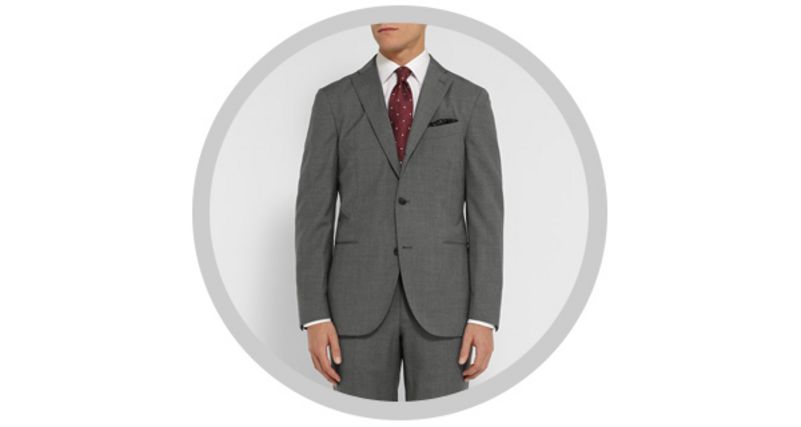
**BOGLIOLI Grey Slim-Fit Virgin Wool Suit **
The most common style of suit, comprising a matching jacket and trousers.
Three-piece
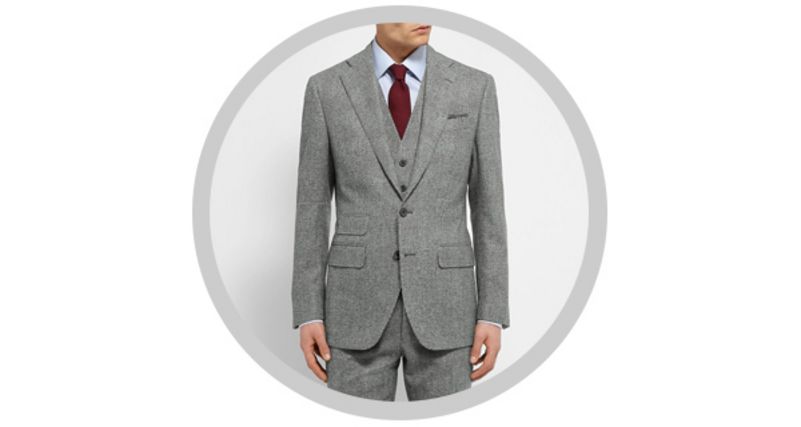
THOM SWEENEY Grey Slim-Fit Prince Of Wales Checked Wool Suit Jacket
A three-piece suit consists of a matching jacket, trousers and waistcoat. The style was popular before the advent of central heating, as the waistcoat provided an additional layer of insulation. It has had a revival in recent years and is regarded as more formal than the standard two-piece, making it a better option for dressier occasions (think weddings and the races) – but it’s also a dapper choice on office-bound days.
Double-breasted suit
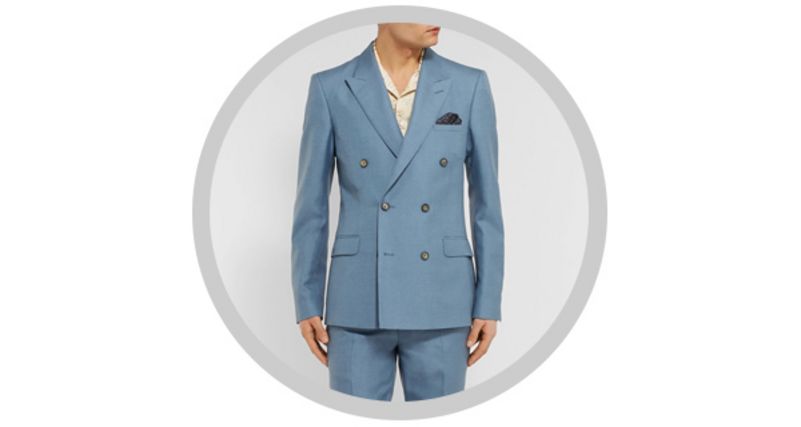
ALEXANDER MCQUEEN Blue Slim-Fit Double-Breasted Mohair And Silk-Blend Suit Jacket
A suit where the front fastening of the jacket overlaps. It usually consists of two vertical rows of buttons, with a single row of buttonholes. There is often a single button on the underside to secure the closure from the inside. Double-breasted styles are best avoided by men with larger frames as they add bulk.
Single-breasted suit
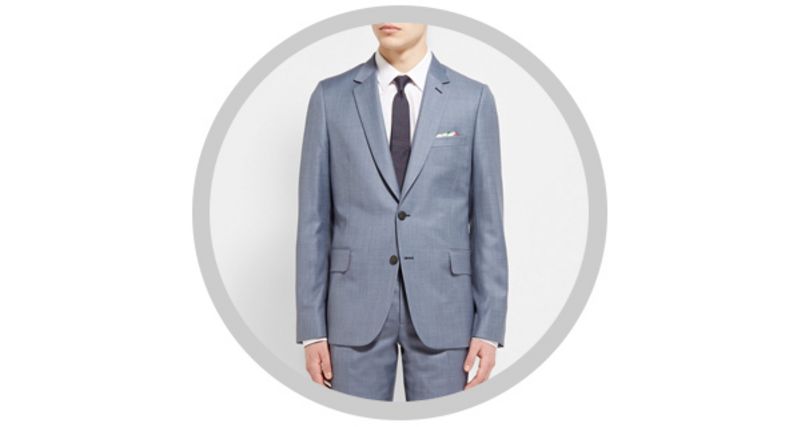
PAUL SMITH Blue Soho Slim-Fit Wool-Twill Suit Jacket
A suit with a jacket that fastens with a single row of one, two, three or occasionally, four buttons. Buttons fastened left over right as standard from the 17th century onwards, apparently so a right-handed man could more easily unfasten his jacket with his left hand and draw his sword with his right, should he find himself in a spot of bother. Single-breasted suits tend to be a cooler option on warmer days, as there’s less fabric than there is with double-breasted styles. Additionally, you can leave a single-breasted jacket unbuttoned without it looking untidy.
Dinner suit
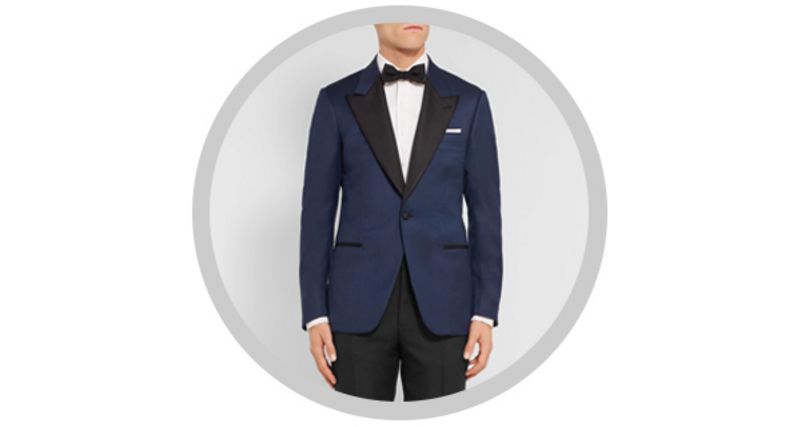
**KINGSMAN Blue Slim-Fit Faille-Trimmed Checked Wool Tuxedo Jacket **
The dinner suit originated from a need for the gentry to change into something clean after spending the day engaged in hunting, shooting and fishing on their estates. Known as a “tuxedo” in the US, it usually consists of a black, white, cream or midnight-blue jacket crafted from wool, and black trousers with a black silk or satin stripe down the side of each leg. The jacket is either double- or single-breasted and is worn with a white double-cuff shirt and black bow tie. It’s the appropriate style of dress for any evening function that stipulates a black-tie dress code – the company Christmas dinner or an evening wedding reception are such examples.

Canvassing
Construction types
This indicates a suit jacket has been constructed with supportive internal padding, which used to be made from horsehair. It means the suit will mould to your body shape with wear and prevents it sagging with age. Most suits are fused using glue and do not have this internal canvassing, so do not last as long.
Deconstructed
This is when a suit is made with a notable absence of structured padding and other reinforcements. It gives it a more laid-back, fluid feel. This construction method was first pioneered by the Italian tailoring houses, which tend to favour a more relaxed approach.
Bespoke
This is when a suit is made to the exact specifications of an individual client, down to the smallest detail, from start to finish. Also known as “custom-made”, it involves a consultation, measuring, fabric selection, cutting and numerous fitting sessions. The name is derived from “bespeak” – an old English phrase which served as an order for something to be made.
Made-to-measure
A step below bespoke, where a partially constructed suit is altered to the measurements of a client.
Ready-to-wear
An off-the-rack suit, that has been cut and sized to fit the most common body shapes.
Keep up to date with The Daily by signing up to our weekly email roundup. Click here to update your email preferences