THE JOURNAL

Kit Harington arrives at our lunch looking fresh-faced and clean-cut. He’s wearing slim jeans and a chunky Loro Piana sweater. Gone are the long curly locks of Jon Snow in Game Of Thrones, as is the pronounced beard his character Sir Henry Muck sports in the new season of Industry. He has just driven into London after dropping off his two children at school in the Suffolk village where he lives with his wife, the actress Rose Leslie.
I had expected Harington to postpone our lunch and the photoshoot that took place the week before. His mother, the playwright Deborah Jane Catesby, with whom he was very close, died from a brain tumour shortly before Christmas. Her funeral took place at the weekend. It’s too soon for him to talk about it publicly, but I suspect some semblance of normality is a tonic after the months Harington and his family lovingly spent caring for her.
Despite still coming to terms with such a momentous loss, Harington is good company: open, charming and funny. Although he often has a resting hangdog expression – not a million miles from the one he had to sport while battling the elements and the White Walkers in eight seasons of Game Of Thrones – that’s not who he is. Or not all the time, at least. And, as he admits, looking miserable can have its benefits.
“I used to be the guy at the party sitting in the corner with the sad face,” he says. “I couldn’t help it. But I’d sit there and people would come over and ask, ‘Are you OK?’ And I’d tell them I was fine. And I was. I was genuinely enjoying myself. But they’d tell me how sad I looked and want to come and look after me. It was a great way to get someone to fetch me a drink; in fact, it was quite a good strategy if I was on the pull,” he laughs.


I should mention here that Harington and I have history. We’ve known each other, on and off, for around 16 years. Before Game Of Thrones, when he was an unknown actor with only a stint in the play War Horse under his belt, he and I and a few other friends used to hang out together. Our friend Richard Madden would frequently invite us all to dinner at his flat in Hampstead on a Friday night and when we’d get there, Madden would announce, each time, that he couldn’t be bothered to cook. The table would be laid, but dinner was nothing more than a main course of vodka and a side of soda. The only ingredients visible were slices of lemon. We would then, drunkenly, either head to The Stag, a nearby pub with a large garden (now closed) or, more often than not, indulge in a game of Chat Roulette.
Does anyone remember Chat Roulette? It was all the rage in 2010. You would enter the website and begin a video chat with whomever appeared on your screen. It was totally random. And at anytime during the encounter, you could press skip and leave them for another random user. You would either find yourself face to face with another group of drunk people sat around a table or, more frequently, someone naked playing with themselves. You just never knew what you were going to get.
Harington was the king of Chat. He would brazenly engage with whomever popped up on the screen and, unashamedly, press skip as soon as he desired, often within seconds. You would see the faces on the screen light up when they spotted this absurdly handsome man peering at them and then – click! – he was gone.
“I had a devil on my shoulder and he was a hard one to let go of”
It was back then that Harington and Madden landed their roles in Game Of Thrones. While we were happy that they’d got work on a forthcoming HBO series, the show sounded terrible. We were sure it would never make it beyond one season. After all, it was a medieval fantasy tale; Harington’s character lived in Winterfell and was called Jon Snow, and Madden’s was called Robb Stark. Who spells Rob with two Bs?
“I know,” Harington recalls. “We sold our merchandise rights at the start because none of us thought it would take off like that. We filmed that first season and it was like one big party. We all worked hard and took our roles seriously, but we had a lot of fun, too. We thought, well, this will last a season and then we’ll go off and do other things and all stay in touch.”
When they’d get back from stints filming in Belfast, the Friday nights with Chat Roulette would continue.
“Chat Roulette was a good marker of Game Of Thrones getting big,” Harington smiles. “When we first played, nobody knew who we were. And as we become more recognised, the reactions online were more extreme. We’d land on someone masturbating and then they’d look up and see me or Richard staring back at them. Click!”

We’ll click back to Game Of Thrones later because, today, we’re primarily here to talk about season four of Industry. If you haven’t seen it, you must. The show, which started off as a story following a group of graduates trying to survive and thrive at an elite investment bank – with graphic portrayals of sex, drugs and power plays along the way – has turned into something a whole lot more. Created and written by Mickey Down and Konrad Kay, who both had stints working in the City, the show has grown from being the least-watched show on HBO to becoming an award-winning, critically acclaimed hit. Its creators cleverly combined culturally relevant storytelling, great writing, nifty casting, innovative filming and the chance for its actors to really go for it. And this is what Harington does this season.
“I was completely enraptured by the show from the first season,” he says. “I think they give every actor the opportunity to really step up and do something interesting. And, as they sometimes do, give a character – as they did mine in episode two of this season – the space to tell his backstory. Mickey and Konrad like giving you something weird, bizarre, fun and drastic to do. And casting characters unexpectedly. I think they did that a bit with me, if I’m honest. They took me and realised that everyone knew me as this thing and went, ‘OK, we’ll go play this thing.’ It’s exactly what I was looking for.”
“I still haven’t watched the final season of Game Of Thrones”
We see Harington’s Henry Muck spectacularly spiral out of control. The substance abuse moves from hedonism to self-medication; the sex shifts from a tool of superiority to self-sabotage; and his born privilege melts from beneath his bespoke-clad feet. I don’t want to give any of the upcoming storylines away, but Harington’s performance in this show is raw, uncomfortable and beautifully played. Some TV critics are already murmuring about it being Emmy-worthy.
It’s also quite brave. Harington, after all, comes from fallen aristocratic stock and spent time in rehab for addiction issues after finishing Game Of Thrones. He has spoken, in the past, about his struggles with his mental health. I ask him if it was triggering revisiting these issues through the character he was playing?
“Well, I’d certainly had a lot of practice,” he laughs. “With Henry, his addiction is twofold. There is very much an actual addiction to substances and wild behaviour and abandon and chaos and euphoria. But as with most drug addicts or alcoholics, there’s also an addiction to try and prove himself in a way. And if you’ve got those two, that’s quite a toxic mix. But having been through that stuff, and lived [in] that world, and shared that combination of addictions, I could empathise with what he was facing.
“But as for whether it was triggering… No, it was fun. You can’t pretend that some of the elements that leads to addiction aren’t fun. There’s a part of me that misses the wild behaviour sometimes. I just realised it’s not sustainable. But playing characters like this lets me revisit it in some way. And I felt safe in the hands of Mickey and Konrad. It’s written so well. They’re going to do the story justice because they’re smart. They know that world. They understand the language, the partying, the codes. And despite the storylines, I’m around a safe group of actors who aren’t actually all wild. They’re really hard-working. So, no, it was good.”


Family life also played its part in keeping him grounded after a day of manufactured mayhem.
“Because Rose and I knew it was going to probably be quite a heavy season with this stuff, and Rose was working in Stratford doing a play, she said, ‘OK, you take the kids while you’re filming in Cardiff’. So, when I’d come back from filming, where I’ve been doing God knows what, I’d walk in the door and the kids were there. And anything dark I’d had to deal with during the day was gone. It was bizarre and it was great. I’d get home and be a dad.”
Harington shows me pictures of the children. Inevitably, they are both beautiful. He loves being a father.
“They’re both awake to the world and they’re kind,” he says. “They are all I want from my children. I have been blessed with two who have both those attributes in spades. Fatherhood happened at just the right time. And I think I’m good at being a dad. My son was born when I was 34 and I realised the other day that when he’s 20, I’ll only be 54. That’s not so old. I’m in a weird moment in my life where, at 39, I’m the same age my mum was when she had me. And I’m in charge of these two. I’m midway through my life. You used to think of your parents’ lives before you came along as being this thing that stretched back to ancient times, but at this point, I’m like, no, it really didn’t. I feel like I’ve hardly started. I feel very grounded. And I’m beating myself up less about stuff.”
“Everything in life up until 27 went so fast. It felt as if the universe was expanding. And then at 28, it just didn’t feel like that anymore and I went to rehab”
After Harington achieved such unprecedented success and fame with Game Of Thrones – he was one of the highest paid actors on television for the last two series; the final episodes were watched by tens of millions of viewers – it did seem that his heart weighed heavy. He seemed less carefree and, of course, being in the public eye had its drawbacks.
When a few of us went to Rome for a weekend in 2015, Harington was mobbed wherever we went. Whether we were sitting at a cafe for breakfast or a bar at night, or just pottering along a side street, he was instantly recognised and asked for photographs. It was quite intense.
At supper one evening, when his resting face looked even more glum than usual – mostly because we were all so hungover – I asked him what was up. He told me it was hard coming to terms, at the age of 27, with the possibility that he’d already reached the pinnacle of his career. Where would he go from here? I understood what he was saying. It was a year later that he first checked himself into rehab.
“I look at it this way,” Harington explains. “Everything in life up until 27 years old went so fast, and it felt as if the universe was expanding, everything was amazing and new and fresh. It was all incredible. And then at 28, it just didn’t feel like that anymore and I went to rehab for the first time.” He left shortly after arriving, however.
“I went, ‘You guys, I’m not doing this.’ I just wasn’t ready. You have to be ready. I told them I knew there was a problem, but I couldn’t deal with it. And then from 28 to 32, it was a slow process of recognising, ‘OK, life doesn’t carry on like that.’ At some point, you’ve got to grow up. And it took a long time for me to do that.”
And amid all of this, Game Of Thrones was coming to an end. It was a lot for him to deal with.
“Yes, I still haven’t watched the final season,” Harington admits. “I have really odd feelings about it because I wasn’t very well. I was in rehab when the final episode aired, so I missed it and then I came out of rehab and had other things on my mind. And then I actually think I look rather unwell in that final season. I’m not well. I’m struggling with alcohol at that point. But I’m quite proud of the work I was doing.”
Harington credits friends, colleagues and most of all his wife, Rose – the Scottish actress who played his love interest in Game Of Thrones – with helping him to face his demons.
“I had a devil on my shoulder and he was a hard one to let go of,” Harington says. “When those close to me begged me to go to rehab, I remember saying that it was unreasonable to ask someone to live a sober life. I didn’t want that. But once you’ve got over it, you don’t think about it anymore. My life is better like this. I just didn’t want to do that to myself anymore. Rehab is also so expensive that you can’t afford to leave. Every time I thought about doing so, I’d imagine burning a suitcase with that amount of money in it.”
A year after rehab, Rose fell pregnant, and then Harington became a father.
“I think it all happened just at the right time,” he smiles. “I’d made some choices, and then everything fell into place. And that’s what I was told would happen if I made those choices. I think that my kids met me at the right time; just like my mum did with me and my brother.”
And now he’s a father of two, living in the outskirts of a village in the Suffolk countryside, soon to celebrate eight years of marriage.
“Rose and I are very caring of each other,” he says. “We’re very loving, and tactile, and we make sure we tell each other that we love each other. Rose is just the most genuine soul. I’m very, very lucky. I really am. And Rose was there through all of the hard stuff, and she’s been through some journeys with me. But it has truly worked out.”

As has his career. It turns out his 27-year-old self was worrying unnecessarily. Harington has cleverly carved out a path that has let him try his hands at a variety of roles and parts that are a million miles away from Jon Snow. On stage, among others, he’s played Henry V and Doctor Faustus. He’s taken cameo roles in TV shows that he admires, appeared as romantic heroes and villains in a number of movies, his production company created and produced an historical drama about the Gunpowder Plot for the BBC – Harington starred as Robert Catesby, the leader of the plot (in fact, an ancestor of his) – and he has just produced and finished an adaptation of Charles Dickens’ A Tale Of Two Cities. Essentially, he’s prioritised range and credibility over big bucks and franchises (with the exception of How To Train Your Dragon and Marvel’s Eternals).
Unnecessarily, perhaps, as he nibbles on a chicken salad and only nicks a few of my fries, I ask how he’s managed to stay in such good shape. At nearly 40, he still appears to have the enviable physique and six-pack he sported when filming Pompeii back in 2014. There are a few scenes in Industry in which Harington is pretty much naked. And by the looks of it, Henry Muck’s heroin addiction has done wonders for his body.
“If I don’t go to the gym at least three times a week, the sad boy in the corner comes back”
“In all seriousness, if I don’t go to the gym at least three times a week – and I do yoga twice a week – my head goes really fucking weird,” Harington says. “I get very depressed. The sad boy in the corner comes back. But when I was playing Henry, I decided I was going to drop a lot of weight for episode two so I would look as if I was on smack. In the end,” he shrugs and laughs, “I just looked ripped. I quite like looking less bulky now. As I get older, I think it looks better. So, I’ve swapped protein shakes for intermittent fasting instead.”

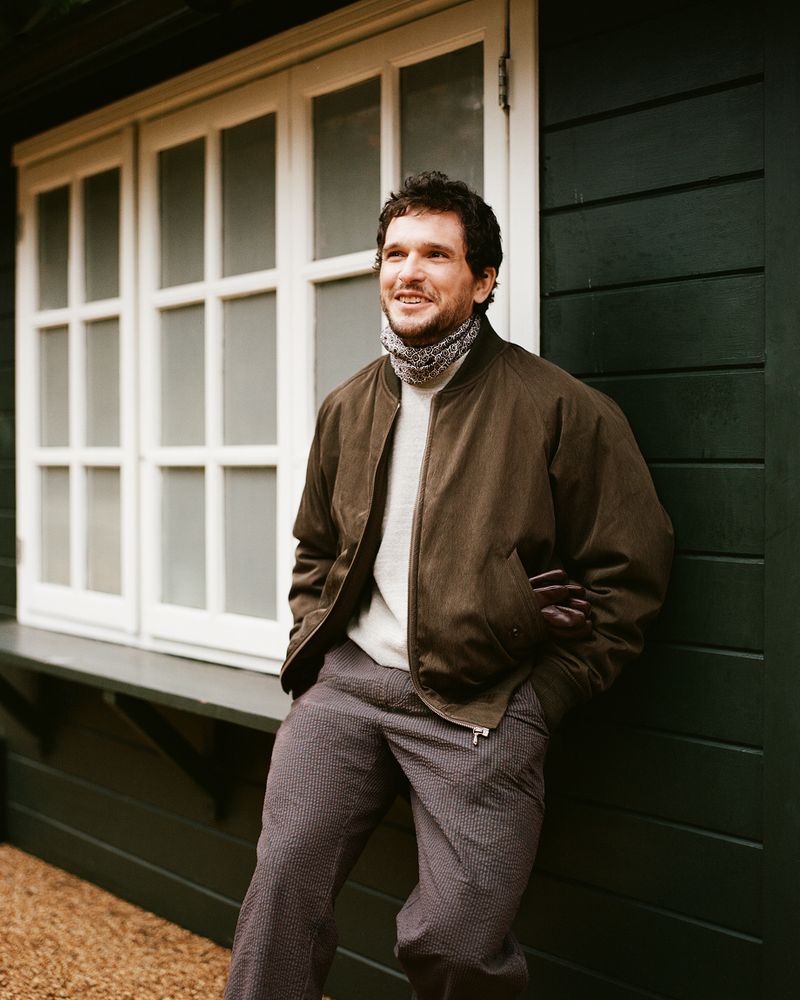
And how did he find modelling for our shoot?
“I enjoyed our shoot because it was clothes I really loved,” he says. “You didn’t make me do anything stupid. Sometimes you’ll come onto a set and they’ll go, ‘Look, here’s all these fun props’. I’ve got a tiny little digital camera. There’s a big white backdrop. And they want you to be a performing monkey. And I just think, why am I actually here? What am I doing? And it takes me right back to a place where I didn’t feel in control.” Harington ended up buying a few of the items he wore in our shoot.
“I’ve always found fashion hard,” he says. “I was always the one dipping his toes into being a skateboarder or a goth. But I had one foot in and one out; I could never quite jump in. And it’s always been that way with fashion and style. It’s not me. I have turned up at various things in slightly wilder outfits, but they’re always half-hearted. I’ve never fully gone for it. I was thinking about what to wear to see you today and I thought I’ll put on the corduroys from the shoot. But then I didn’t think I had any shoes that went with them and just thought, fuck it, I’ll wear slightly tight jeans and a baggy sweater. I really enjoyed the clothes they put me in for Industry, though.”
I ask Harington if he’s going to miss Sir Henry Muck, as well as his wardrobe, when the series ends. The viewers certainly will. And nobody yet knows if there will be another season. Nor if Muck will survive to see it.
“I think I like him a bit too much,” he smiles. “People are, like, he’s despicable, isn’t he? He’s such a prick. And in my head, I’m thinking, hmm, is he? I think he’s probably the devil on my shoulder.”
Industry season four is on HBO/BBC now